
Solar panels can help Bridgend homeowners and businesses reduce electricity costs, generate cleaner energy and become less dependent on the National Grid.
However, the results will depend on the property, roof suitability, energy consumption and quality of the system design. This guide explains the main points to consider before arranging a solar panel installation in Bridgend.
Do solar panels work effectively in Bridgend?
Solar panels generate electricity from daylight, so they do not require continuous sunshine or hot weather. Although output is higher on bright summer days, a professionally designed system can continue producing useful electricity during cloudy conditions.
The amount of electricity generated will depend on:
- Roof direction and pitch
- Available roof space
- Shading from trees, chimneys and nearby buildings
- Panel output and efficiency
- Inverter capacity
- Local weather conditions
- Quality of the system design
An unshaded south-facing roof will generally provide the highest annual generation. However, east- and west-facing roofs can also deliver worthwhile results.
East-facing panels generate more electricity during the morning, while west-facing panels produce more later in the day. This can work well for households that use more electricity before and after work.
Solar panels for Bridgend homes
A domestic solar installation should be designed around the household’s current electricity consumption and future energy plans.
A typical home may use solar electricity to power:
- Washing machines and dishwashers
- Home-office equipment
- Refrigeration and general appliances
- Immersion heaters
- Heat pumps
- Electric vehicle chargers
- Battery-storage systems
Households occupied during the day can often use a larger proportion of their solar generation directly. Those that are empty during daylight hours may benefit from appliance timers, smart controls or battery storage.
The installer should also consider whether the household plans to add an electric vehicle, heat pump or other high-demand electrical equipment in the future.

Commercial solar panels in Bridgend
Commercial solar panels can help businesses reduce operating costs and improve their environmental performance.
They can be particularly effective for premises that consume substantial electricity during daylight hours, including:
- Offices
- Workshops
- Warehouses
- Retail premises
- Manufacturing facilities
- Farms
- Community buildings
- Sports clubs
- Schools and care facilities
Because many businesses operate while the panels are generating, a commercial system may achieve a high level of self-consumption.
Before recommending a system, the installer should assess:
- Annual or half-hourly electricity consumption
- Daytime energy demand
- Available roof or ground space
- Roof condition and structural capacity
- Three-phase electrical infrastructure
- Export limitations
- Future business expansion
- Electric vehicle charging requirements
- Battery-storage options
A commercial proposal should clearly explain the estimated annual generation, expected self-consumption, projected financial return and assumptions used in the calculation.
Is battery storage worthwhile?
Battery storage allows surplus solar electricity generated during the day to be stored and used later.
For homeowners, this can reduce the amount of grid electricity purchased during the evening. For businesses, a battery may help manage peak demand, support later operating hours or make better use of compatible time-of-use tariffs.
Battery storage may help to:
- Increase solar self-consumption
- Reduce evening grid usage
- Store surplus daytime generation
- Charge from cheaper off-peak electricity
- Improve energy monitoring
- Reduce peak-time consumption
- Provide backup electricity where specifically designed
Battery capacity should be matched to the property’s expected generation and consumption. A battery that is too large may rarely reach full charge, while one that is too small may not store enough surplus electricity.
Battery storage can often be added to an existing solar installation. However, the inverter, electrical system, metering equipment and existing panels must first be checked for compatibility.
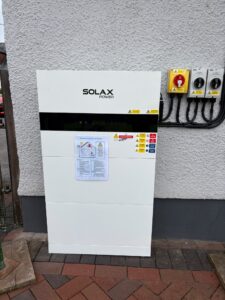
Will the battery work during a power cut?
Not automatically.
Most standard grid-connected solar and battery systems shut down during a power cut to protect engineers working on the electricity network.
Backup power requires compatible equipment and a purpose-designed arrangement. The installer should explain which circuits will remain operational, the maximum power available and how long the battery is expected to last.
Get in touch
If you are considering solar panels or battery storage in Swansea, the Big Green Solar team can assess your property, electricity usage and future energy requirements before preparing a tailored quotation. Visit Big Green Solar or call 0333 210 0083.
For insulation, rendering, roofing and other property-improvement services, visit LMG Home Improvements or call 0333 210 0083 to discuss your requirements.