
Solar panels can help Llanelli homeowners reduce electricity bills, generate cleaner energy and become less dependent on the National Grid.
However, deciding whether solar PV is a worthwhile investment requires more than selecting a set of panels. Homeowners should consider the installation price, likely annual generation, potential savings, export payments and whether battery storage would improve the overall return.
This guide explains the main costs and financial considerations for anyone researching solar panels in Llanelli.
Do solar panels work effectively in Llanelli?
Solar panels generate electricity from daylight rather than heat. They continue working during cloudy conditions, although output will naturally be higher on bright summer days.
The performance of a solar PV system will depend on:
- Roof direction and pitch
- Available roof space
- Shading from trees, chimneys and nearby buildings
- Panel output and efficiency
- Inverter capacity
- Local weather conditions
- Overall system design
An unshaded south-facing roof will normally provide the highest annual generation. However, east- and west-facing roofs can also produce worthwhile results.
East-facing panels generate more electricity during the morning, while west-facing panels generate more later in the day. This can suit households that use electricity before and after work.
The Energy Saving Trust estimates that an east- or west-facing system may generate approximately 15–20% less electricity than an equivalent south-facing installation.
Can Llanelli homeowners receive export payments?
Eligible households can receive payments for surplus electricity through the Smart Export Guarantee.
The Smart Export Guarantee enables eligible small-scale generators to receive payments from electricity suppliers for electricity exported to the National Grid.
Export rates and conditions vary between suppliers. Homeowners should compare:
- Export payment per kilowatt-hour
- Import electricity charges
- Contract length
- Smart-meter requirements
- Eligibility conditions
- Treatment of battery exports
- Exit fees or restrictions
The company providing the export tariff does not necessarily have to be the same company supplying electricity to the property.
An MCS certificate and Distribution Network Operator documentation may be required when applying for a tariff.
What is the likely solar panel payback period in Llanelli?
The payback period is the time required for electricity savings and export payments to recover the original installation cost.
Current Energy Saving Trust figures use Aberystwyth as a Welsh example and indicate a payback period of approximately nine to ten years, depending on household occupancy. These figures are based on July 2026 energy prices.
Llanelli is not identical to Aberystwyth, so this should only be treated as an indicative Welsh comparison. The actual payback period for an individual property could be shorter or longer.
Factors affecting payback include:
- Initial installation cost
- System size and annual generation
- Roof direction and shading
- Household electricity consumption
- Daytime self-consumption
- Import electricity prices
- Export tariff rates
- Battery cost and performance
- Equipment maintenance or replacement
- Future electricity prices
A household that uses a high proportion of its solar generation will normally receive more value from each unit than one that exports most of its electricity at a lower rate.
Payback should therefore be calculated using the customer’s electricity bills, occupancy pattern and proposed system.
Will battery storage improve the return?
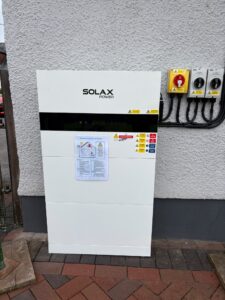
Battery storage allows surplus solar electricity generated during the day to be stored and used later.
This can be particularly useful for households that consume more electricity during the evening, after solar output has reduced.
A battery may help homeowners:
- Use more of their solar electricity
- Reduce evening grid consumption
- Store surplus daytime generation
- Charge during cheaper tariff periods
- Avoid some peak-rate electricity purchases
- Monitor energy use through an app
Energy Saving Trust guidance indicates that domestic battery storage commonly costs approximately £5,000–£8,000. The actual price will depend on the usable capacity, inverter arrangement, installation requirements and equipment selected.
Because a battery increases the original investment, it may improve self-consumption without necessarily shortening the total payback period. Its financial effect should be calculated separately.
How should a battery be sized?
Battery capacity should be matched to the property’s generation and electricity consumption.
The installer should assess:
- Expected daily solar generation
- Daytime electricity use
- Available surplus generation
- Evening demand
- Battery usable capacity
- Charging and discharging rates
- Battery efficiency
- Import and export tariffs
- Planned electric vehicles or heat pumps
An oversized battery may rarely reach full charge. A battery that is too small may not store enough electricity to meet the household’s evening demand.
Get in touch
If you are considering solar panels or battery storage in Swansea, the Big Green Solar team can assess your property, electricity usage and future energy requirements before preparing a tailored quotation. Visit Big Green Solar or call 0333 210 0083.
For insulation, rendering, roofing and other property-improvement services, visit LMG Home Improvements or call 0333 210 0083 to discuss your requirements.