
Solar panels in Maesteg can help homeowners and businesses reduce electricity costs, generate cleaner energy and become less dependent on the National Grid.
However, a successful solar PV installation requires more than fitting panels to an available roof. Roof condition, orientation, local shading, electricity consumption, inverter capacity and battery storage will all affect performance.
Maesteg’s valley setting also makes a detailed shading assessment particularly important. Properties on different streets—or even opposite sides of the same street—can experience different levels of sunlight.
This guide explains the main costs, benefits and installation requirements for anyone considering solar panels in Maesteg.
Do solar panels work effectively in Maesteg?
Solar panels generate electricity from daylight rather than heat. They continue producing power during cloudy weather, although output is higher on bright summer days and lower during winter.
Annual generation depends on:
- Roof direction and pitch
- Available roof space
- Shading from hills, trees and buildings
- Panel efficiency
- Inverter capacity
- Roof condition
- Local weather
- Overall system design
An unshaded, south-facing roof usually delivers the highest annual output. However, east- and west-facing roofs can also support worthwhile installations.
East-facing panels produce more electricity during the morning, while west-facing panels generate more later in the day. This can suit homes where electricity consumption is highest before and after work.
Can Maesteg property owners receive export payments?
Eligible solar panel owners can apply for payments through the Smart Export Guarantee.
Ofgem’s Smart Export Guarantee guidance explains that qualifying small-scale generators can receive payments from electricity suppliers for electricity exported to the National Grid.
Rates and conditions vary between suppliers. When comparing export tariffs, consider:
- Payment per kilowatt-hour
- Contract length
- Import electricity charges
- Smart-meter requirements
- Eligibility criteria
- Whether battery exports are included
- Exit fees
- Requirements to purchase electricity from the same supplier
An MCS certificate and evidence that the appropriate network connection process has been completed may be required.
Is battery storage worthwhile?
Solar battery storage allows surplus electricity generated during the day to be saved for use later.
For homeowners, a battery can reduce evening grid consumption and increase the proportion of solar electricity used inside the property.
For businesses, battery storage may help:
- Store unused solar generation
- Reduce peak-time grid consumption
- Support evening operations
- Use compatible off-peak tariffs
- Improve energy management
- Provide backup electricity where specifically designed
Battery capacity should be matched to generation and consumption. An oversized battery may rarely charge fully, while an undersized unit may provide insufficient electricity for evening demand.
The installer should assess:
- Expected solar generation
- Typical daily electricity consumption
- Daytime self-consumption
- Available surplus electricity
- Evening demand
- Battery usable capacity
- Charging and discharging rates
- Inverter compatibility
- Electricity tariff options
Battery storage increases the initial project cost. Although it may improve self-consumption, it does not automatically shorten the overall payback period. Solar-only and solar-with-battery projections should therefore be shown separately.
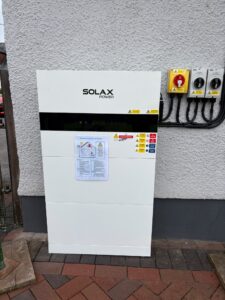
Will a battery work during a power cut?
Not automatically.
Most grid-connected solar systems shut down during a power cut to protect engineers working on the electricity network.
Backup electricity requires compatible equipment and a purpose-designed arrangement. Customers requiring this feature should ask:
- Which circuits will remain operational
- How much power will be available
- How long the battery may last
- Whether solar panels can recharge it during an outage
- Whether changeover is automatic
Supporting selected essential circuits is generally simpler than providing whole-property backup.
Get in touch
If you are considering solar panels or battery storage in Swansea, the Big Green Solar team can assess your property, electricity usage and future energy requirements before preparing a tailored quotation. Visit Big Green Solar or call 0333 210 0083.
For insulation, rendering, roofing and other property-improvement services, visit LMG Home Improvements or call 0333 210 0083 to discuss your requirements.